A food developer choosing a food color powder needs to think about more than storage convenience. Powder has to disperse evenly, fit the mixing sequence, and suit the moisture level of the recipe. In acidic foods, the pigment also has to remain visually stable once acids, flavors, and other ingredients are added. FoodRGB offers several natural colors in powdered form, but the best choice still depends on the finished product. Testing the powder in the complete formula gives a clearer answer than comparing dry samples on a bench.
Acidic Recipes Need Early pH Checks
Fruit beverages, gummies, jellies and fruit preparations often sit at a lower pH, which can change the way plant-based pigments appear. Measuring the final formula is more useful than relying on the pH of water or one ingredient. Acids from fruit, flavor systems, minerals, and sweeteners can shift the environment after blending. A small bench trial should therefore include the full recipe at realistic levels. That lets developers see whether the chosen shade stays balanced before the product moves into heating, cooling, filling, or another processing step.
Powder Must Disperse Before It Can Perform
Uneven dispersion can make a technically suitable color look like the wrong choice. Fine particles may gather in one area, especially in thick mixes or dry blends, creating darker spots and pale sections. Pre-dispersing the powder in a compatible liquid or blending it first with another dry ingredient can sometimes help, depending on the recipe. The useful method is the one that matches commercial equipment. Developers should copy the planned addition order during trials so they can judge both color strength and distribution under conditions that resemble normal production.
Elderberry Fits Strongly Acidic Applications
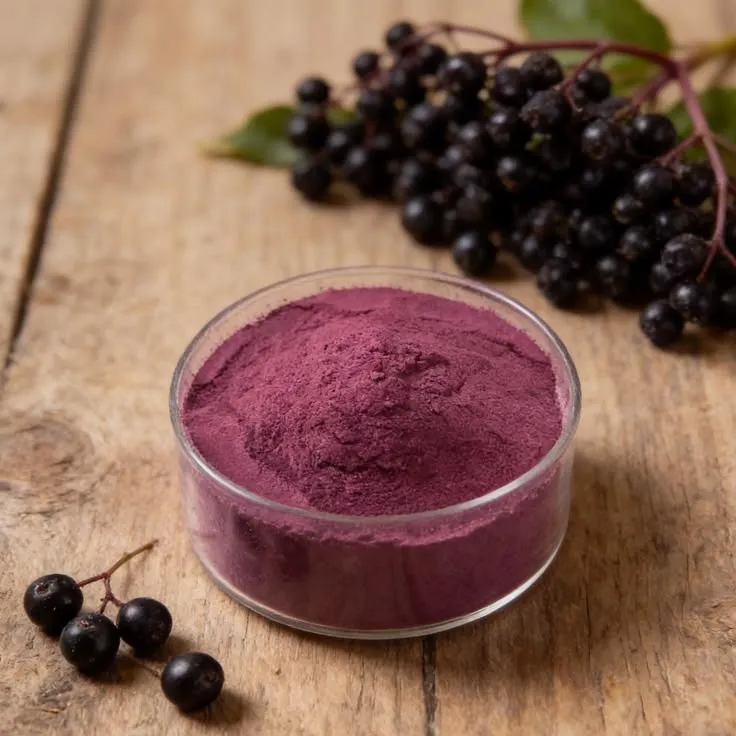
FoodRGB’s Elderberry Color is a powdered, water-soluble option that produces shades from vibrant red to warm purple. The company lists a preferred pH range of about 2.5 to 4.5 and offers 5% and 10% powder strengths. Applications include beverages, fruit preparations, confectionery, juice, frozen drinks, cocktails, mocktails, and jelly. Those characteristics make elderberry worth testing in acidic formulas where a red-purple tone is wanted. The exact result still depends on concentration, pH, and the other ingredients surrounding the pigment in the finished product.
Heat Data Needs Practical Context
FoodRGB’s product page lists black elderberry as heat stable in its specification area, while its FAQ more cautiously describes the color as heat resistant rather than fully heat stable. That distinction is worth respecting during formulation. A hot-filled drink, gummy syrup, baked filling, and frozen beverage face very different temperature histories. Instead of relying on one label, developers should run the color through the exact heating and cooling sequence planned for production. Comparing the sample afterward shows whether the shade remains suitable for that particular process.
Packaging Can Change the Visual Result
A successful production sample still has to survive the package and shelf life. Clear bottles and jars expose colors to more light than opaque containers, while oxygen and storage temperature can also influence appearance. Powdered color should first be stored according to supplier guidance, then the finished product should be checked in its intended pack. Keeping samples from pilot batches and reviewing them at planned intervals can reveal slow fading or tone movement. That information is especially useful when two formulations look equally good immediately after processing.
Scale-Up Can Expose Hidden Mixing Issues
A laboratory beaker gives close control over every addition, but commercial mixers create different shear, circulation and holding times. A powder that disperses well in a small test may behave quite differently in a big tank or kettle. Pilot production should include samples from several points in the batch so the team can check uniformity. If the shade varies, the answer may be a change in pre-dispersion, addition order, or mixing time rather than more pigment. Solving that issue early makes routine manufacturing easier to repeat consistently.
Conclusion
Powdered natural colors can be practical for commercial foods, but convenience alone does not determine whether they will work. pH, dispersion, heat, packaging, scale, and storage all influence the final appearance, especially in acidic products. Elderberry shows how a powder can offer useful red-to-purple shades within a specific formulation range while still needing real process testing. Manufacturers can use foodrgb.com to review natural color systems and technical support. The strongest choice is the one proven in the complete recipe, through production, and again during realistic shelf-life checks.