
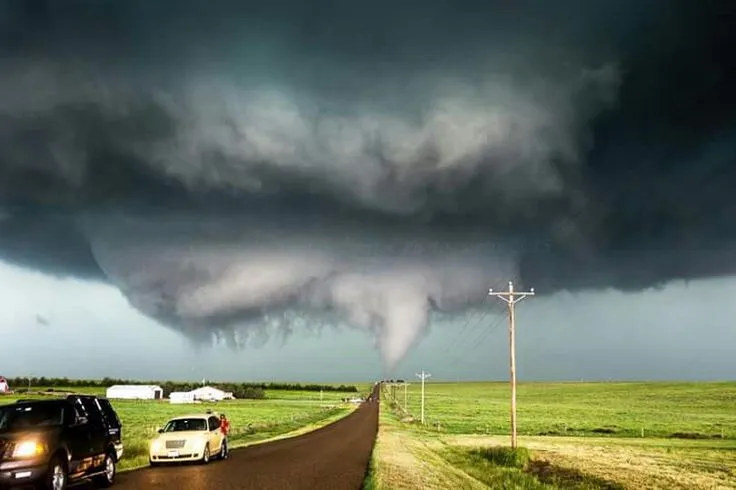
Weather can feel surprisingly small in everyday life. A rain shower passes over a neighborhood, clouds cover a city, and a forecast is often reduced to a few symbols on a phone. Traveling across the Plains changes that perspective. People interested in storm chasing tours USA 2027 can encounter weather across landscapes open enough to reveal just how large atmospheric systems and individual thunderstorms can appear.
Scale is one of the hardest qualities to communicate through photographs or forecasts. Standing beneath a broad sky while a storm develops miles away provides a different sense of proportion. The relationship between clouds, horizon, precipitation, and landscape can become one of the most memorable aspects of the journey.
The Horizon Becomes a Measuring Tool
Open terrain provides visual references that help travelers understand distance. A line of trees, a rural road, or a small town on the horizon can appear tiny beneath a developing thunderstorm. These familiar objects make the sky seem even larger.
For first-time visitors to the Plains, this contrast can be striking. Clouds that might be partly hidden by buildings or terrain elsewhere can sometimes be viewed across a much wider portion of the horizon.
Storm Towers Reveal Vertical Scale
Developing thunderstorms do not simply spread horizontally. Strong cloud towers can grow dramatically upward, creating a vertical dimension that ordinary photographs sometimes struggle to convey. Watching that growth from the ground can be fascinating. A cloud that initially occupies a modest part of the sky may become a dominant feature later in the afternoon.
Travelers who photograph the development periodically can create a useful visual record of how dramatically its proportions changed.
Distance Can Improve Perspective
Getting closer to a weather feature does not necessarily make its size easier to appreciate. When observers are too close to a large storm, much of the structure may extend beyond their field of view. A greater distance can reveal more of the complete scene.
This is particularly useful for landscape photography. Including foreground and horizon elements gives the viewer reference points, helping communicate the dimensions of the weather far more effectively than an isolated photograph of clouds.
Rain Shows How Much Space a Storm Occupies
Travelers considering tornado chasing 2027 Wichita Kansas may naturally focus on cloud formations, but precipitation can also demonstrate atmospheric scale. From a suitable viewpoint, rainfall may appear as a broad curtain extending from the cloud toward the ground. Separate precipitation areas can occupy different parts of the horizon, adding depth to the scene.
Changing light can make these features even easier to see, particularly when sunlight reaches rain from an angle.
Roads Emphasize Distance
Long Plains highways provide another strong visual reference. A road narrowing toward the horizon naturally communicates distance and can make the sky above it feel enormous. For photographers, this creates straightforward compositions without requiring elaborate equipment.
Useful scale references can include:
-
Straight rural highways
-
Agricultural fields
-
Distant buildings
-
Grain elevators
-
Tree lines
-
Utility poles
-
Small town skylines
The weather remains the main subject, while the landscape explains its size.
Different Cloud Layers Add Depth
Atmospheric scale is not limited to one thunderstorm. Multiple layers of clouds can occupy different heights and distances, creating a scene with considerable visual depth. Lower clouds may move across the foreground while taller formations rise much farther away. Clear sections between them can reveal still more distant portions of the sky.
Noticing these layers encourages travelers to view the atmosphere as a three-dimensional environment rather than a flat ceiling overhead.
Photography Works Best When Context Remains
Zooming tightly into an interesting cloud detail can produce an attractive photograph, but taking every image this way removes much of the context. Alternating between close details and wide compositions creates a stronger collection. The close photographs show texture, while the wider ones reveal scale and location. A field occupying only a narrow portion of the frame beneath an enormous sky can sometimes communicate the character of Plains weather better than a technically complicated photograph.
Scale Changes the Way Weather Is Remembered
After returning home, travelers may remember more than individual storm features. The overwhelming size of the sky, the distance across the landscape, and the relationship between weather and open country can remain equally vivid. This is something statistics alone cannot easily communicate. Knowing the dimensions of a storm is different from standing in a landscape where its size can be experienced visually.
Conclusion
The Great Plains provide an unusual opportunity to appreciate atmospheric scale. Open horizons, distant rainfall, towering clouds, layered skies, and long roads give travelers visual references that reveal just how expansive weather can become.
For guests traveling with Storm Chasing Adventure Tours, experiencing this scale firsthand can add a new dimension to storm observation, turning the enormous relationship between land and sky into one of the journey’s defining memories.